About Sword Runner
Grey means avoid, ember means cut
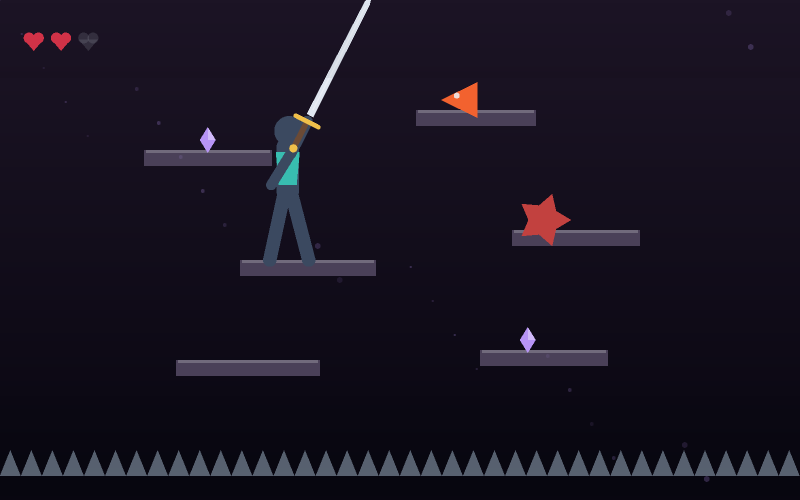
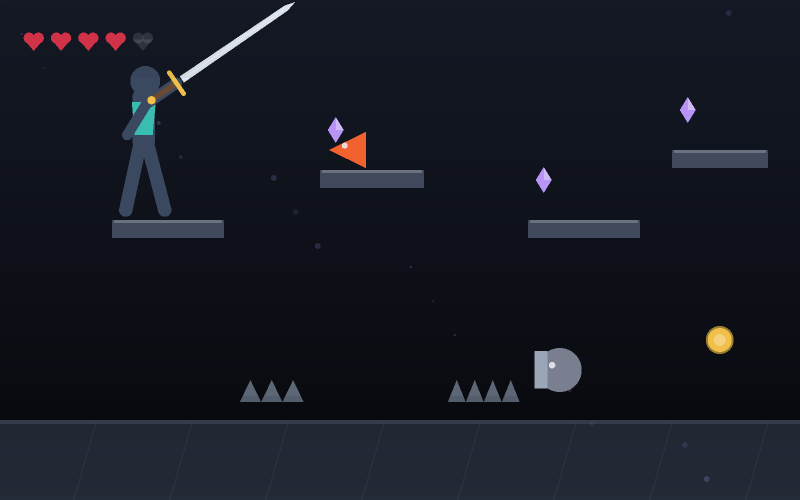
Solid obstacles are grey stone and cannot be destroyed. Breakable ones are outlined in ember orange with a pulsing interior. That distinction is the single most useful thing to internalise, because it is used identically in Samurai Dash and Sword Sprint.
Cutting a barricade scores between 140 and 300 points depending on how well timed the swing was. Jumping over one scores nothing and breaks your combo, which is the game's way of saying that avoidance is a fallback rather than a strategy.
The corollary is that a barricade is an opportunity rather than a threat, and a block is a threat rather than an opportunity. Reading which one is arriving is most of the skill.
Reading ahead rather than reacting
At full speed you are handling roughly one and a half obstacles ahead of the one you are currently passing. Players who watch their character do consistently worse than players who watch the right edge of the screen, because by the time an obstacle reaches your character the decision should already have been made.
The gap between obstacles shrinks as speed climbs but never falls below about 0.62 seconds of travel - the time a person actually needs to see, decide and act. A run should end because you misread something, not because the game stopped being possible.
Coyote time and buffered jumps
The jump has a tenth of a second of coyote time after leaving the ground, and a jump pressed shortly before landing is remembered and fires the moment the ground is available again.
Neither of these makes the game easier in any way a player consciously notices. What they remove is the class of failure where you pressed the right button at approximately the right time and the game said no. Without them, a fast runner does not feel hard - it feels broken.
How to play
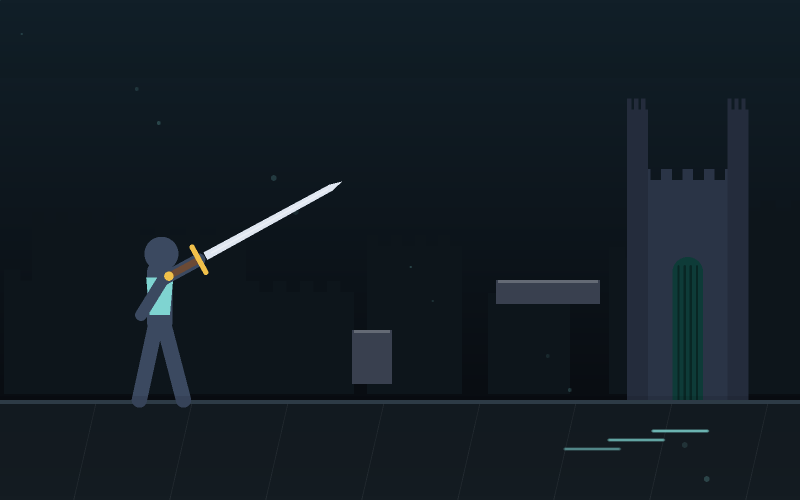
- Press Start. Your character runs on its own; you only decide what to do about what arrives.
- Press Up to jump over grey blocks on the ground.
- Press Down to slide under high beams. Jumping into a beam is the most common way a run ends.
- Press Space to cut anything outlined in ember. Cutting scores; going around it does not.
- Three hearts. Every collision costs one.
Controls
| Where | What to do |
|---|---|
| Jump | Up arrow or W |
| Slide | Down arrow or S |
| Cut | Space, J or K |
| Mouse / touch | Tap the top third to jump, bottom third to slide, middle to cut |
| Touch buttons | Jump, Slide and Slash under the canvas |
| Pause | Escape or P |
Scoring
These are the point values this game awards, before the combo multiplier is applied where it uses one. Hit quality changes the figure: a strike at the centre of the correct moment is worth substantially more than one at the edge of it.
Tips
- Watch the right edge of the screen. You are reading ahead, not reacting.
- Ember outline means cut. It is worth more than any obstacle you avoid.
- Slide under beams; do not try to jump them. That single mistake ends most early runs.
- A slide pressed in mid-air becomes a fast drop, which is useful when a jump went long.
- If you keep dying at the same speed, you have hit a reading limit rather than a reflex one.
- Combo multiplies the small per-obstacle score, so a clean stretch is worth far more than it looks.
Common mistakes
- Jumping at a high beam. It is the obstacle specifically designed to punish the reflex answer.
- Avoiding barricades instead of cutting them, which scores nothing and breaks the combo.
- Watching your character rather than the obstacles arriving.
- Panicking at high speed. The gap between obstacles has a floor and never becomes unfair.
Features
- Three obstacle types with a colour rule shared across the whole runner category
- A minimum obstacle gap tied to human reaction distance, not to a difficulty number
- Coyote time and input buffering on every jump
- Mid-air slide that converts into a fast drop
- Three parallax layers whose scroll speed is tied to the actual run speed
- One-thumb touch controls with screen-third tap zones