About Blade Tower
One-way platforms, and why they matter
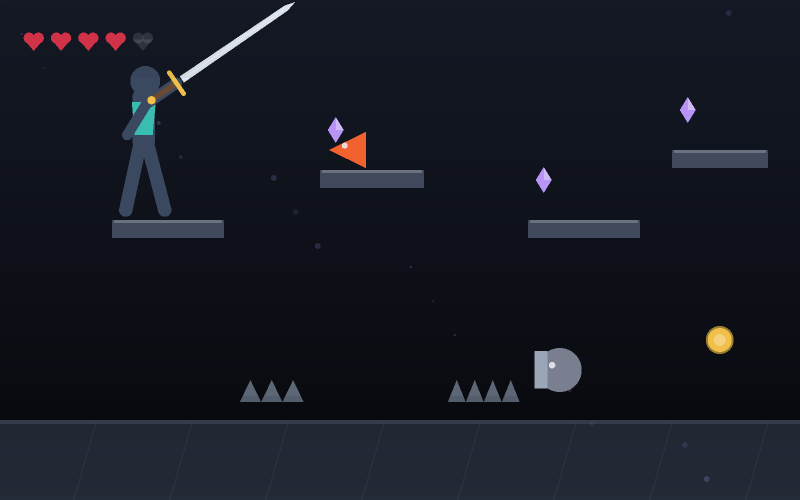
Every platform can be passed through from below and landed on from above. Without that rule, a vertical course is unreadable: every jump risks clipping the underside of the platform you were aiming for, and the player cannot tell a mistake from a collision bug.
With it, the only question a jump asks is whether you will reach the ledge, which is a question you can answer by looking. The climb becomes about choosing a route rather than about fighting the geometry.
Patrols, not pursuers
Enemies here walk their ledge and turn at the ends. They do not chase, do not leave their platform, and are entirely predictable.
That is deliberate. A chasing enemy in a vertical climber turns every route decision into a panic; a patrolling one turns it into arithmetic. The question becomes which ledge is worth landing on, and whether you have time to deal with what is standing on it.
Thornballs cannot be cut at all, and a ledge with one on it is often simply a ledge to skip. Recognising that quickly is most of what separates a floor-twenty run from a floor-fifty one.
The dark, and what climbing early buys you
The rising darkness accelerates from about 42 pixels per second to 120 as you gain height. That means the higher you get, the less time you have to choose a good ledge.
Climbing quickly early buys the room to be careful later. A run that dawdles through the first twenty floors arrives at floor forty with the dark right behind it and no margin for a bad jump, which is exactly when the ledges become sparsest.
A permanent bar in the corner shows how far above the dark you are. It is the only real threat in the game and it gets a permanent readout.
How to play
- Press Start. Left and Right move; Up jumps.
- Platforms are one-way: you pass up through them and land on them coming down.
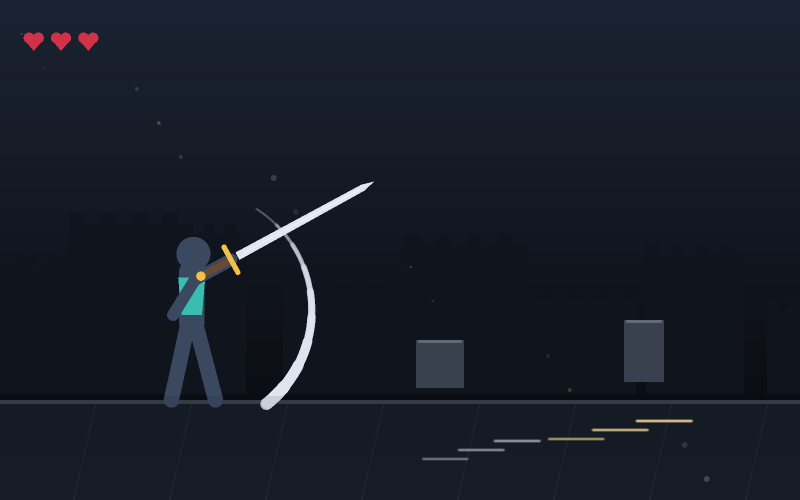
- Press Space to cut patrolling enemies. Thornballs cannot be cut - route around them.
- The darkness below rises faster the higher you get. Never stop climbing.
- Every tenth floor is marked and pays a bonus. Three hearts, and falling into the dark ends the run.
Controls
| Where | What to do |
|---|---|
| Move | Left and Right arrows, or A and D |
| Jump | Up arrow or W |
| Cut | Space, J or K |
| Touch | Move, Jump and Slash buttons; tap the upper screen to jump |
| Pause | Escape or P |
Scoring
These are the point values this game awards, before the combo multiplier is applied where it uses one. Hit quality changes the figure: a strike at the centre of the correct moment is worth substantially more than one at the edge of it.
Tips
- Climb quickly early. The dark accelerates, so height bought cheaply now is time later.
- A ledge with a Thornball on it is usually a ledge to skip entirely.
- Taking a hit knocks you upward rather than down - it costs a heart, not your position.
- Look one floor ahead before you jump, not at the ledge you are aiming for.
- Every tenth floor is labelled and worth 500. They also mark how far you have come.
- Hearts appear as pickups on about one ledge in six. Detouring for one is often worth it.
Common mistakes
- Stopping to clear a ledge you did not need to land on.
- Attacking a Thornball, which does nothing and costs you the time.
- Climbing into a dead end because you only looked at the next ledge.
- Treating the early floors as safe. They are, but the time spent there is not free.
Features
- One-way platforms so a jump only ever asks whether you will reach
- Patrolling enemies that stay on their ledge and never chase
- A rising darkness that accelerates with height
- A permanent readout of your distance above the dark
- Floor milestones every ten floors with a bonus and a label
- Damage knockback that pushes you upward rather than into the dark