About Pixel Sword Quest
Fights you are allowed to skip
Each level contains enemies placed on specific ledges with a limited patrol range. Almost none of them stand between you and the key. You can fight the patrol on the middle ledge, or you can jump the gap above it and never meet it at all.
Health does not refill inside a level, which is what makes that a real decision rather than a preference. A fight you win at the cost of two hearts is a fight that may have cost you the run three rooms later, even though you won it.
The rule worth applying is to ask what a fight is for. If the answer is nothing, walking past is usually the stronger play, and the score supports that: crystals are worth more than kills.
Three levels, three shapes
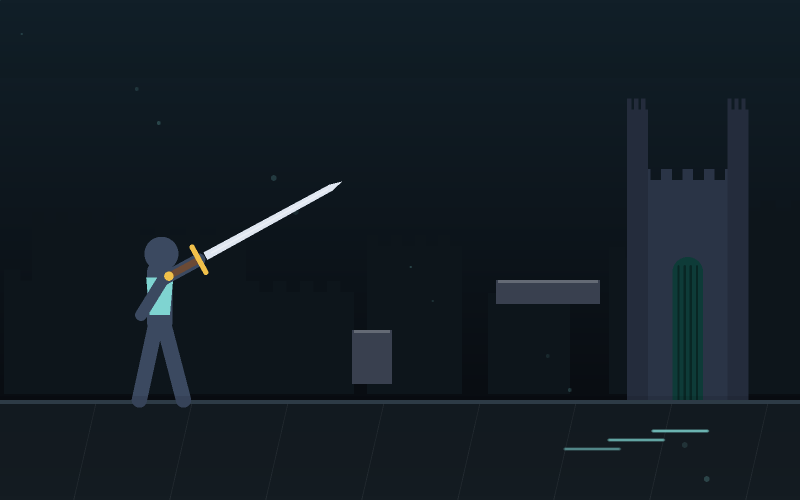
The Undercroft is wide and mostly flat, with spike gaps between floor sections. It teaches the jump distance and the fact that most enemies can be bypassed.
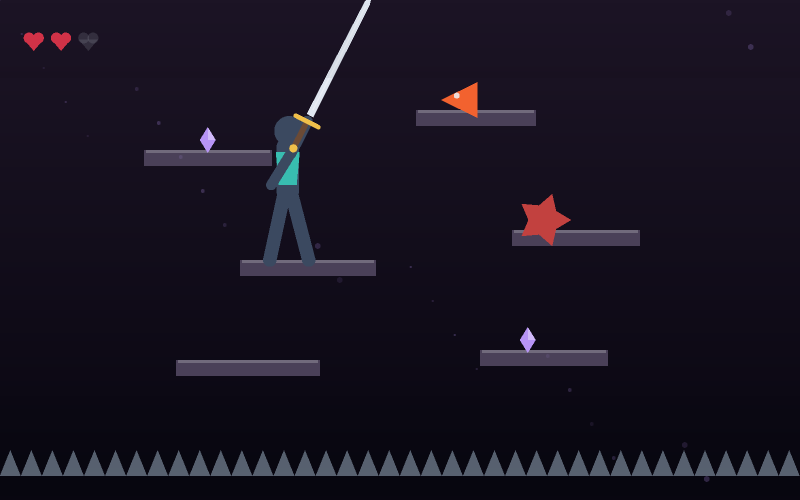
The Rune Steps is vertical, built from ascending ledges over a floor that is largely spikes. The key sits at the top of the climb, which means the return journey is a descent through ground you already know.
The Black Gate is the longest and mixes both, with a Grinder on the floor and casters on high ledges. It is the only level where fighting is sometimes genuinely mandatory.
Keys, doors and crystals
Every level has one key and one door. The door glows teal once the key is held and stays dark until then, so there is never a question of whether you are ready to leave.
Crystals are scattered along both the direct route and the awkward one. They are worth 120 points each with a combo multiplier applied, which makes a thorough run worth meaningfully more than a fast one - as long as the thoroughness does not cost hearts.
How to play
- Press Start. Left and Right move; Up jumps.
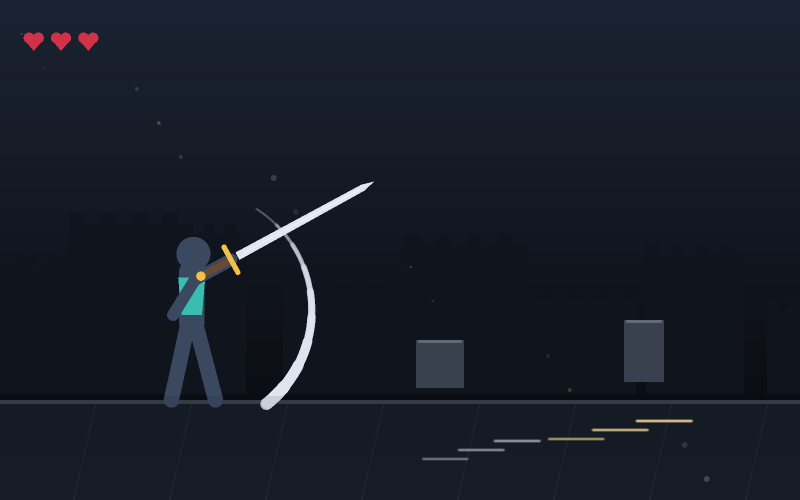
- Press Space to cut. Most enemies can be avoided entirely rather than fought.
- Find the key - it floats and glows gold - then reach the door at the far end.
- Collect crystals along the way. They are worth more than kills.
- Health does not refill inside a level. One heart is restored between levels.
- Falling off the bottom costs a heart and returns you to the level start.
Controls
| Where | What to do |
|---|---|
| Move | Left and Right arrows, or A and D |
| Jump | Up arrow or W |
| Cut | Space, J or K |
| Touch | Move, Jump and Slash buttons; tap the upper screen to jump |
| Pause | Escape or P |
Scoring
These are the point values this game awards, before the combo multiplier is applied where it uses one. Hit quality changes the figure: a strike at the centre of the correct moment is worth substantially more than one at the edge of it.
Tips
- Ask what a fight is for. If nothing is behind it, walking past is usually stronger.
- Crystals score more than kills, and most crystals are safer than most enemies.
- The door stays dark until you have the key, so you can always tell whether you are ready.
- Thornballs cannot be cut. Jump over the ledge they are on.
- Casters on high ledges are worth killing, because bolts follow you across the level.
- Health only returns between levels. Finish a level cheaply rather than completely.
Common mistakes
- Clearing every enemy out of habit, which arrives at level three with one heart.
- Trying to cut a Thornball instead of going round it.
- Falling off the bottom while chasing a crystal that was not worth the jump.
- Missing the key and walking the whole level to a door that was never going to open.
Features
- Three hand-built levels with fixed enemy and crystal placement
- Enemies confined to a patrol range, so most fights are genuinely optional
- One key and one door per level, with the door lit only once the key is held
- Health that does not refill inside a level
- One-way thin ledges alongside solid geometry
- Coyote time and buffered jumps on every jump