About Sword Duel Arena
Three opponents, three problems
Warden Kesh comes first and is the closest thing here to a training dummy that fights back. He attacks often, guards rarely, and telegraphs everything with a wind-up long enough to see, decide and answer. If you can beat him consistently, you have understood the attack structure.
Sister Vey inverts the problem. She holds a guard, waits, and punishes anything thrown carelessly at it. Attacking into a raised guard costs her a point of stamina, and when her stamina reaches zero the guard breaks and she is open for most of a second. She is beaten by pressure, not by patience.
The Ninth Blade is fast, commits to heavy attacks nearly half the time, and will trade hits with you all day. Trading is exactly what loses to her, because her damage output is higher than yours. The answer is the long recovery on her heavy attacks - step out, let it whiff, and take the free hit.
Why the recovery window decides the fight
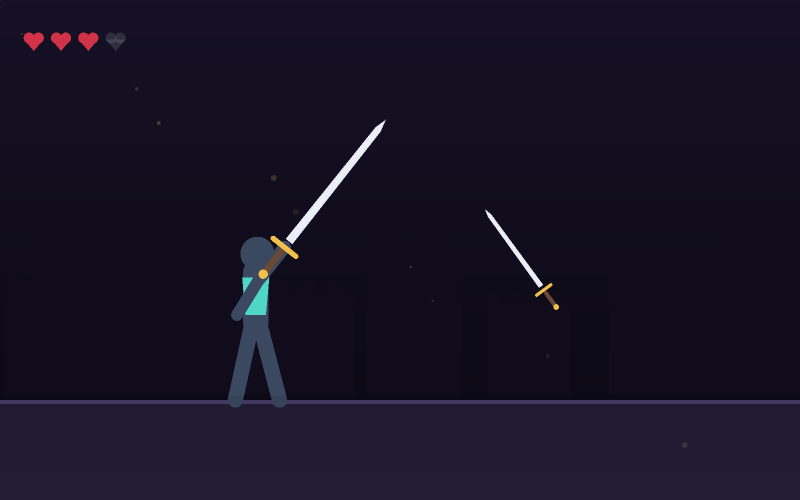
Every attack, yours and theirs, has three phases. The wind-up draws the blade back and hurts nothing. The active window is about a tenth of a second and is the only part that connects. The recovery is what happens afterwards, and during it the fighter who swung cannot block, dodge or attack.
A heavy attack that misses leaves its owner in recovery for over half a second. That is an enormous amount of time in a fight measured in tenths, and it is where nearly every hit you land in this game will come from.
The corollary is uncomfortable but true: attacking because you saw movement is how you lose. If you swing during their wind-up, your recovery lines up precisely with their active window.
Stamina is a decision, not a restriction
Light attacks cost one stamina, heavy attacks cost two, and the bar refills after a short pause rather than continuously. Nothing prevents you from emptying it in a flurry; the game simply lets you, and then lets your opponent do what an opponent does to someone with no options left.
The habit worth building is keeping one point in reserve so a dodge is always available. The habit worth breaking is treating a full bar as something to spend.
Parrying, and why holding a guard does not work
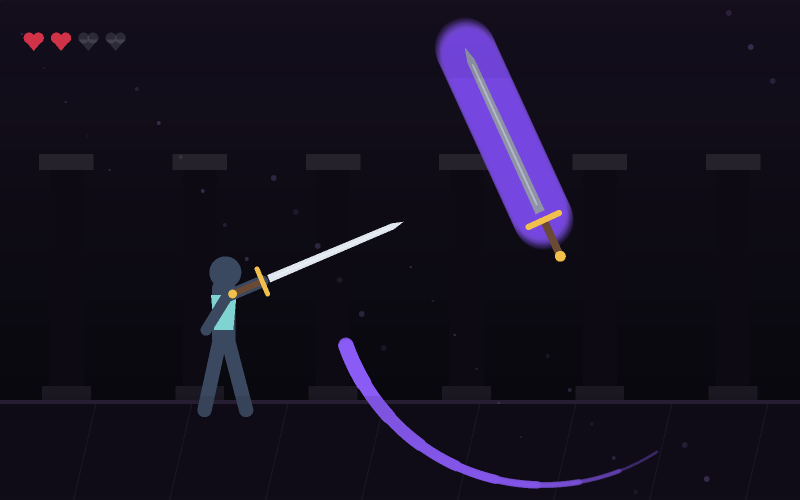
A guard raised inside about 190 milliseconds of an attack landing counts as a parry. Parries cost no stamina, stagger the attacker for nearly a second, and pay a large score bonus. A guard that was already up is a plain block: it absorbs the hit but costs a stamina point every time.
That difference is deliberate. Holding a guard permanently is a losing strategy against every opponent in the roster, because they will simply keep hitting it until it breaks. The guard is a tool for the moment an attack arrives, not a state to live in.
How to play
- Press Start, then use the arrow keys or A and D to control the distance between you and your opponent.
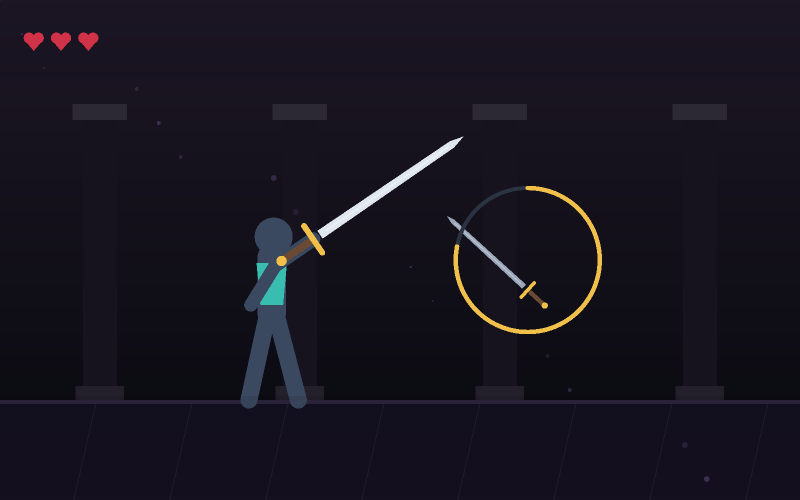
- Watch for the wind-up: a gold wedge means a blockable attack, and the opponent's shoulder moves before the blade does.
- Hold Shift as the attack arrives to parry it, or step out of range instead.
- Press Space for a light attack the moment their swing has missed and they are recovering.
- Use K for a heavy attack only against a staggered or recovering opponent - its own recovery is long.
- Clear all three duels to win. Two health are restored between rounds.
Controls
| Where | What to do |
|---|---|
| Move (desktop) | Left and Right arrows, or A and D |
| Light attack | Space or J |
| Heavy attack | K |
| Guard / parry | Hold Shift |
| Mouse | Click low to strike, click high for a heavy attack |
| Touch | Step buttons, Guard, Light and Heavy under the canvas |
| Pause | Escape or P |
Scoring
These are the point values this game awards, before the combo multiplier is applied where it uses one. Hit quality changes the figure: a strike at the centre of the correct moment is worth substantially more than one at the edge of it.
Tips
- Watch the shoulder rather than the blade - the wind-up starts before the sword moves.
- Against Sister Vey, keep attacking her guard. Four blocked hits break it and hand you the round.
- Against The Ninth Blade, never trade. Step back, let the heavy miss, then take the punish.
- Keep one stamina point in reserve so a guard is always available.
- A parry is worth more than a hit, because it creates the opening for the hit as well.
- Distance is a defence. Backing out of range costs nothing and beats blocking every time.
Common mistakes
- Swinging as soon as the opponent moves - that is their wind-up, and your recovery meets their blade.
- Holding Shift permanently. Every blocked hit costs stamina, and a broken guard is worse than being hit.
- Using heavy attacks as an opener. Its recovery is the longest in your kit.
- Emptying the stamina bar in a flurry and then having nothing left to dodge with.
- Backing into the edge of the arena, where stepping out of range stops being an option.
Features
- Three hand-tuned opponents with genuinely different behaviour, not one opponent with more health
- Full three-phase attack system with visible wind-up telegraphs
- Parry window that rewards timing a guard rather than holding one
- Stamina that limits attacks, guards and dodges from one shared pool
- Guard-break mechanic for pressuring defensive opponents
- Personal bests stored in your own browser