About Retro Sword Duel
Built to be readable rather than to be hard
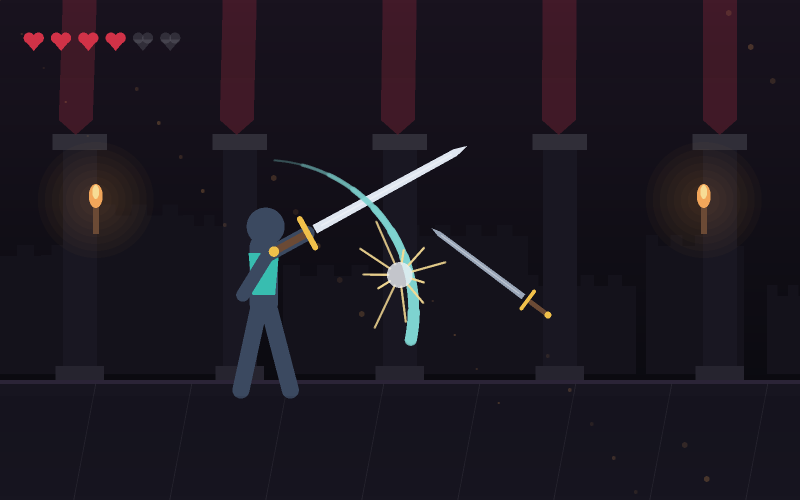
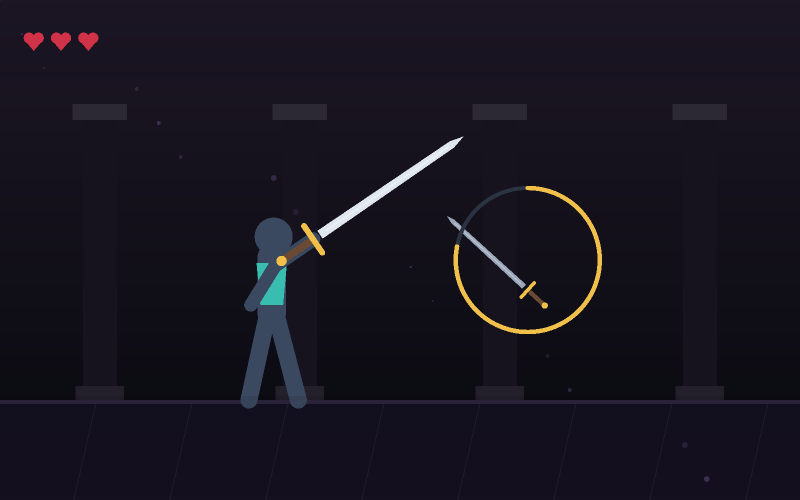
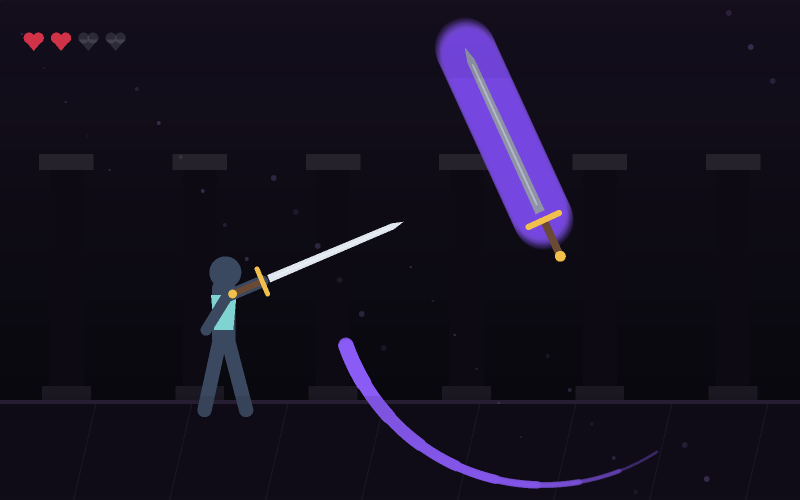
Every fighter in this game snaps to an eight-pixel grid, and the pose changes completely between wind-up, strike and recovery rather than shifting subtly. In the wind-up the blade is behind the fighter's head. In the strike it is thrust straight forward. In the recovery it has dropped low.
That is not nostalgia for its own sake. Removing sub-pixel motion makes the exact frame an attack becomes active far easier to see, and three unmistakable poses mean you can identify the phase from across the arena without having learned anything yet.
The game also names what is happening in words. When the opponent begins a wind-up it says so; when they enter recovery it tells you to hit now. Those prompts exist here and nowhere else on the site, because this is the teaching game.
Three bouts, and none of them get genuinely hard
The opponent gains health and a little speed each bout, but even at bout three it is slower than the opening opponent in Sword Duel Arena. It never uses a heavy attack and never uses an unblockable one.
This is deliberate. Retro Sword Duel is not meant to be a challenge you graduate from by getting good at it; it is meant to be a place where the three-phase attack structure is visible long enough to actually see.
The parry window is twice as wide here
Most games on the site use a parry window of about 180 milliseconds. This one uses 280, which is generous enough that a deliberate, unhurried reaction lands it.
Once parrying feels natural here, Sword Duel Arena's window will feel tight rather than impossible - which is the whole point of playing this first.
How to play
- Press Start. Watch the opponent rather than your own fighter.
- When the message says the opponent is drawing back, get ready - the blade is behind their head.
- Hold Shift as the strike arrives to block or parry it.
- When the message says they are recovering, press Space immediately. The blade will be down at their side.
- Win three bouts. Each one gives the opponent slightly more health.
Controls
| Where | What to do |
|---|---|
| Move (desktop) | Left and Right arrows, or A and D |
| Strike | Space, J or K |
| Guard / parry | Hold Shift |
| Mouse | Click the play area to strike |
| Touch | Step, Guard and Strike buttons under the canvas |
| Pause | Escape or P |
Scoring
These are the point values this game awards, before the combo multiplier is applied where it uses one. Hit quality changes the figure: a strike at the centre of the correct moment is worth substantially more than one at the edge of it.
Tips
- Read the messages. They exist only in this game and they say exactly what to do.
- The blade behind the head means wind-up. The blade at the side means recovery.
- The parry window here is nearly three tenths of a second - you do not need to rush it.
- Do not move much. Distance control matters far less here than timing.
- If you can beat bout three without losing health, you are ready for Sword Duel Arena.
Common mistakes
- Attacking during the wind-up because it looks like an opening. It is the opposite.
- Holding Shift the entire round. Blocking still costs stamina, even here.
- Ignoring the on-screen prompts, which are the fastest way to learn the poses.
- Treating this as a game to beat rather than a game to learn on.
Features
- Grid-aligned pixel rendering that makes attack phases unmistakable
- On-screen prompts naming the wind-up and the recovery as they happen
- A parry window nearly twice the width used elsewhere on the site
- No heavy attacks and no unblockable attacks anywhere in the game
- Three short bouts that never become genuinely difficult
- Local personal bests, stored in your browser only