About Sword Catch
Three answers, not two
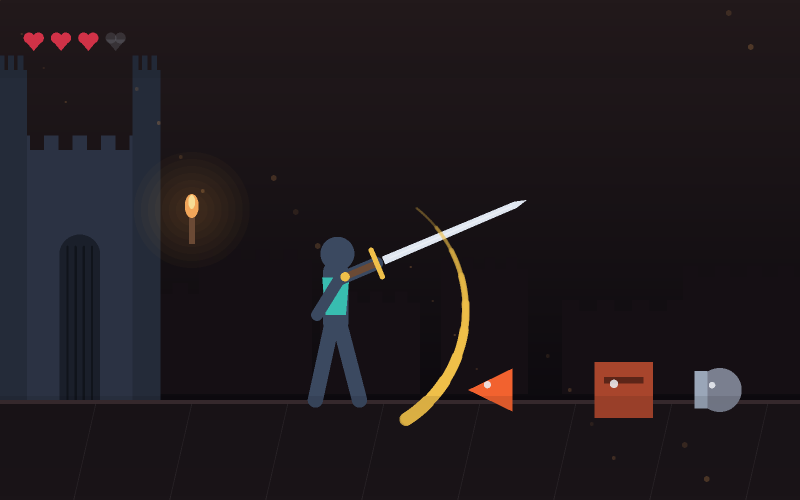
Orange shards should be cut. Gold crates should be caught, which means standing in their lane and not swinging. Red thorns should be left alone, which means being in a different lane entirely when they land.
A two-way choice - cut or dodge - becomes automatic within about thirty seconds. Three answers, where one of them is deliberate inaction, keeps the decision alive because it is genuinely possible to be actively wrong in two directions.
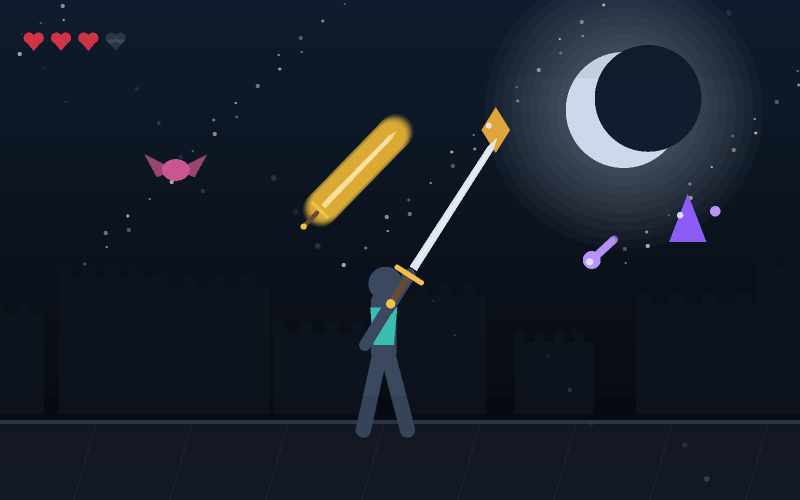
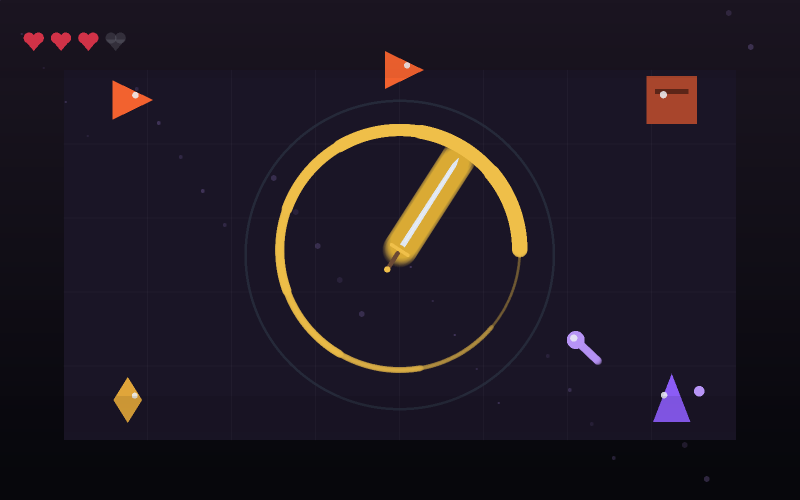
Every class has a distinct shape as well as a distinct colour: a four-pointed shard, a square crate with a cross on it, a spiked ball. The game is fully playable without relying on colour.
Carrying compounds
Catching a crate does not score it immediately. Each crate you are carrying makes the next one worth 80 more, so a run of five caught in sequence is worth substantially more than five caught separately.
Catching a thorn drops everything you were carrying and costs a heart, which is what makes a long carry a genuine risk rather than passive accumulation. The more you hold, the more a single lane misjudgement costs.
Letting things through is a scored action
A thorn that reaches the floor pays 50 points with the combo applied. That is not a large number, but it exists specifically so that correct inaction is rewarded rather than merely tolerated.
Most falling-object games only reward doing things. This one rewards recognising when the right move is to be somewhere else, which is a different skill and the one the game is actually about.
How to play
- Press Start. Left and Right move between the five lanes.
- Press Space to swing. Swinging cuts whatever is in your lane at blade height.
- Orange shards: cut them. Gold crates: stand in the lane and do not swing.
- Red thorns: be in a different lane. Letting one land pays a small bonus.
- Every crate you carry makes the next one worth more. Catching a thorn drops them all.
- Four hearts.
Controls
| Where | What to do |
|---|---|
| Change lane | Left and Right arrows, or A and D |
| Swing | Space, J or K |
| Touch | Tap a lane to move to it; tap your own lane to swing |
| Touch buttons | Left, Slash and Right under the canvas |
| Pause | Escape or P |
Scoring
These are the point values this game awards, before the combo multiplier is applied where it uses one. Hit quality changes the figure: a strike at the centre of the correct moment is worth substantially more than one at the edge of it.
Tips
- Shape matters as much as colour: four points is a shard, a square is a crate, spikes are a thorn.
- Each crate you hold makes the next one worth 80 more. A run of five is worth far more than five ones.
- Move out of a thorn's lane early. Deciding late is how carries get dropped.
- Letting a thorn land is worth 50. Correct inaction is scored here.
- Cutting a crate destroys it. When in doubt in a crate lane, do not swing.
- The key in the corner stays on screen. Use it until the shapes are automatic.
Common mistakes
- Swinging reflexively in a crate lane, which destroys the thing you were meant to catch.
- Staying in a thorn's lane because you were focused on something else falling.
- Building a large carry and then taking a lane risk you would not have taken empty-handed.
- Treating this as a two-way game. The third answer is doing nothing, and it scores.
Features
- A genuine three-way decision where one answer is deliberate inaction
- Distinct shapes as well as colours, so it is playable without colour
- A carry system where each held crate raises the value of the next
- Correct inaction scored rather than merely tolerated
- A permanent on-screen key to the three object classes
- One-thumb touch play - tap a lane to move, tap your lane to swing