About Flying Blade
One blade, and the cost of missing
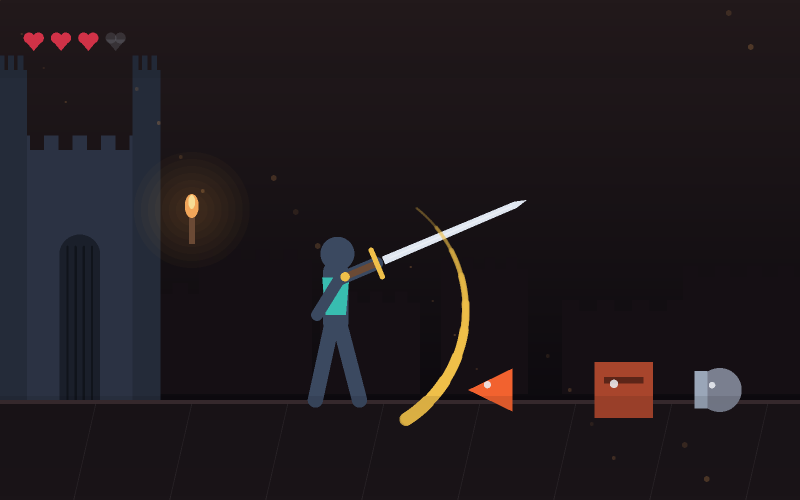
You have exactly one sword and it can only be thrown once at a time. A throw that misses leaves you unarmed for the second or so it takes to travel out, turn, and return.
That is the tension the whole game runs on. Every throw is a commitment with a real cost, and the difference between a good player and a new one is mostly how many throws they decline to make.
The blade's status is printed permanently in the corner - in hand, out, or returning - because it is the most important thing to know and the easiest thing to lose track of.
The return trip cuts too
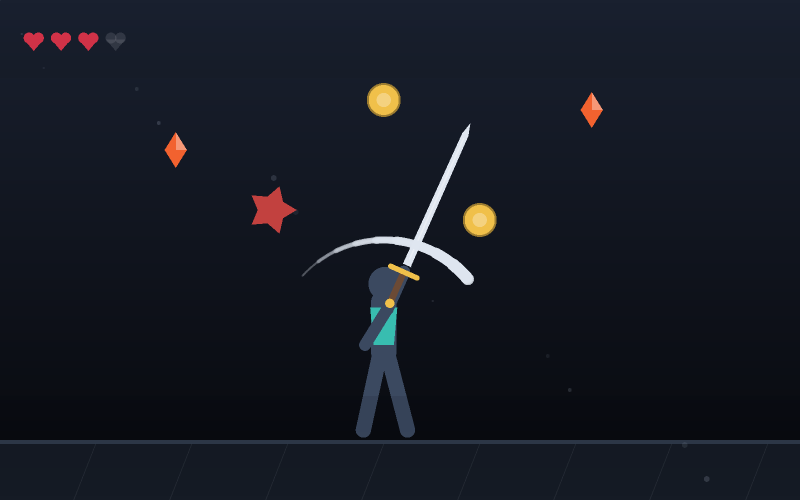
When the blade turns for home, its hit list is cleared. Anything it already passed is fair game again, and a kill on the return is worth 240 points against 140 on the way out.
That means a throw which misses on the way out is not wasted - the return path is a second chance, and a player who keeps tracking the blade after it has passed its target will land far more than one who looks away.
Deflecting a bolt on the return is worth 320, the highest single value in the game, because it means one throw did two jobs.
Leading a moving target
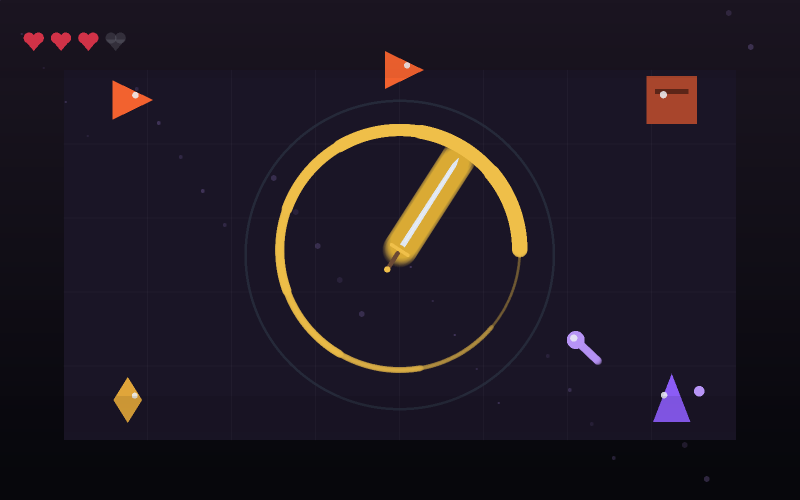
Flying enemies cross the screen at a constant speed with a sine wave added, and a short dotted preview shows where each will be shortly. That preview turns the throw from a guess into a lead.
The blade travels at 700 pixels per second, so at typical distances the lead is around a fifth of a second of the enemy's travel. Aiming at the end of the dotted line rather than at the enemy itself is the single adjustment that makes the game click.
Anything that crosses the whole screen costs a heart. Ignoring a flyer is never free.
How to play
- Press Start. Aim with the mouse, or steer with the Left and Right arrows.
- Press Space, or click, to throw. You only have one blade.
- The blade travels out, turns, and returns to your hand on its own.
- It cuts on the way out and again on the way back - the return is worth more.
- A swing that catches a caster bolt deflects it for a large bonus.
- Four hearts. Anything that crosses the screen costs one.
Controls
| Where | What to do |
|---|---|
| Aim | Mouse position, or Left and Right arrows |
| Throw | Space, J, K, or click |
| Touch | Tap where you want the blade to go |
| Pause | Escape or P |
Scoring
These are the point values this game awards, before the combo multiplier is applied where it uses one. Hit quality changes the figure: a strike at the centre of the correct moment is worth substantially more than one at the edge of it.
Tips
- Aim at the end of the dotted preview line, not at the enemy.
- Keep watching the blade after it passes its target. The return trip is a second chance.
- A missed throw leaves you unarmed for about a second. Decline throws you are not confident in.
- Deflecting on the return is the best action in the game - one throw doing two jobs.
- The status line in the corner tells you whether the blade is available. Read it.
- Enemies that reach the far edge cost a heart, so nothing can safely be ignored.
Common mistakes
- Throwing at where an enemy currently is rather than where it will be.
- Looking away once the blade has passed its target and missing the return cut.
- Throwing at a distant target and having nothing in hand when a closer one arrives.
- Assuming a flyer that missed you is harmless. Crossing the screen costs a heart.
Features
- A single thrown blade that must return before it can be thrown again
- Return-trip cuts worth substantially more than outbound ones
- Mid-air bolt deflection, worth the most of any action
- Dotted movement previews on every airborne enemy
- Permanent blade-status readout
- Fully playable with a single tap on touch