


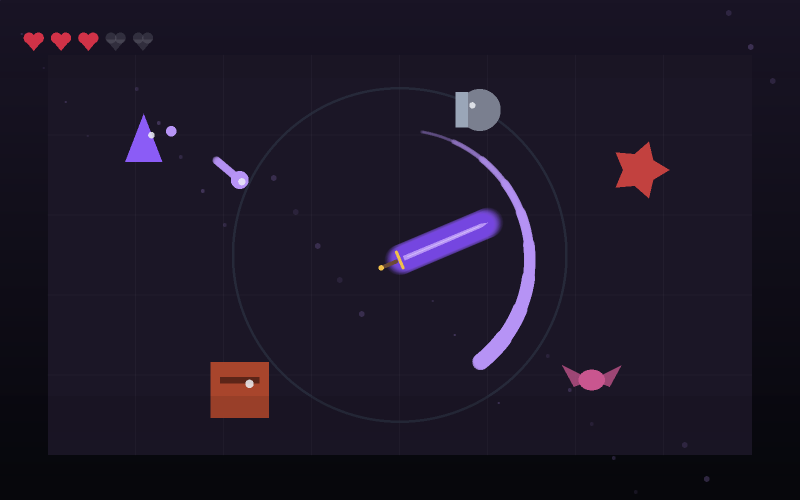
About Sword Survival Games games
Crowd control is the actual skill
The mistake every new player makes is fighting the enemy in front of them. In a survival arena the enemy in front of you is rarely the problem; the two closing in from behind while you deal with it are. Every game in this category is designed so that standing still and swinging eventually fails, no matter how good your timing is.
The technique that works is simple to describe and hard to do: keep moving in one direction, let the crowd string out into a line behind you, and turn to fight only the front of that line. A group of eight enemies chasing you becomes eight individual fights instead of one fight against eight.
Arena corners are where runs end. The wall removes half your escape routes and the enemies know where you are going before you do.
Reading the roster
Enemy types are introduced at fixed waves rather than randomly, so each new silhouette arrives on its own and can be learned before the next one appears. Rushers are fast and die in one hit. Dodgers sidestep an attack thrown on reflex and punish it. Shielded enemies absorb light attacks from the front and have to be flanked or hit heavy. Brutes are slow, take four hits, and telegraph an unblockable slam you are meant to walk away from rather than answer.
Casters keep their distance and throw bolts, which makes them the priority target even though they are the least immediately threatening. Spikers cannot be attacked at all and exist purely to make part of the arena unusable.
Nothing in the roster is a damage sponge for the sake of it. Every type changes how you have to move, which is the reason later waves feel different rather than merely busier.
Why the combo multiplier matters more than damage
Points come from hits multiplied by a combo counter that rises every third connected strike and resets when you take damage. At its ceiling the multiplier is worth eight times the base value of every hit, which means a clean run through wave six will out-score a sloppy run through wave ten.
This is what makes survival games a scoring genre rather than an endurance one. Surviving longer helps, but surviving longer without being touched helps far more.
Where to start
Blade Rush is the introduction: a single stream of enemies from one side, which teaches timing without asking you to watch your back. Blade Survivor opens the arena to all four sides and is where positioning starts to matter.
Arena Swords is the full top-down version with obstacles. Monster Blade adds the fantasy roster, and Blade Survival 100 is a hundred-encounter gauntlet that is meant to take several attempts.
Tips for this category
- Never fight in a corner. Walk out of it before you swing, even if that means taking a step back first.
- Move in circles around the outside of the arena so the crowd strings out into a line.
- Kill casters first. They are the only enemies that can hit you while you are dealing with something else.
- The combo multiplier is worth more than any single kill - avoiding one hit is worth more than landing three.
- Heavy attacks hit multiple enemies. Use them on the line, not on a single rusher.
- When a brute winds up, walk away. Blocking it costs you stamina you will want in four seconds.